Is A Balcony Cabin Worth It On A Fjord Cruise?
When a balcony cabin earns its price on an overnight fjord cruise, when shared viewing areas may be enough, and how to assess a separate Oslofjord day outing.
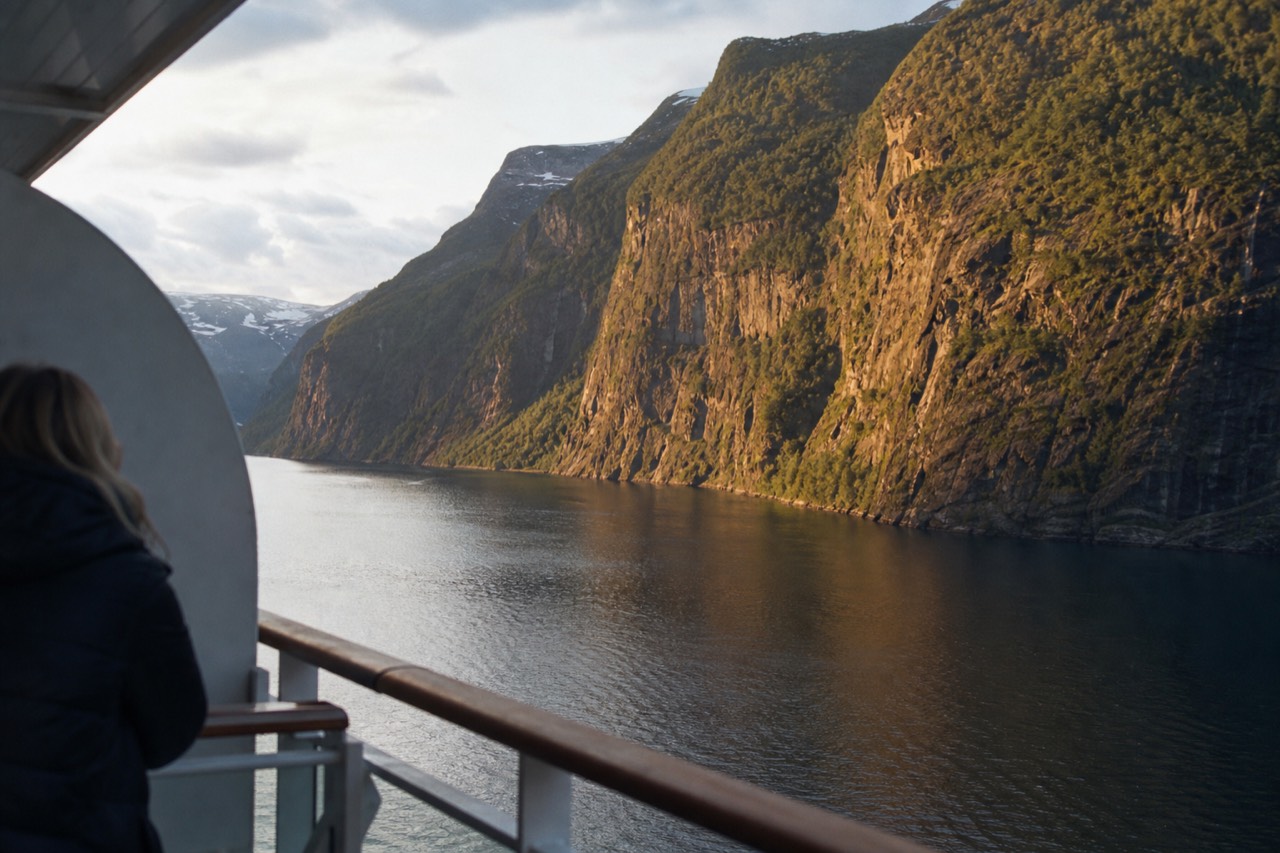
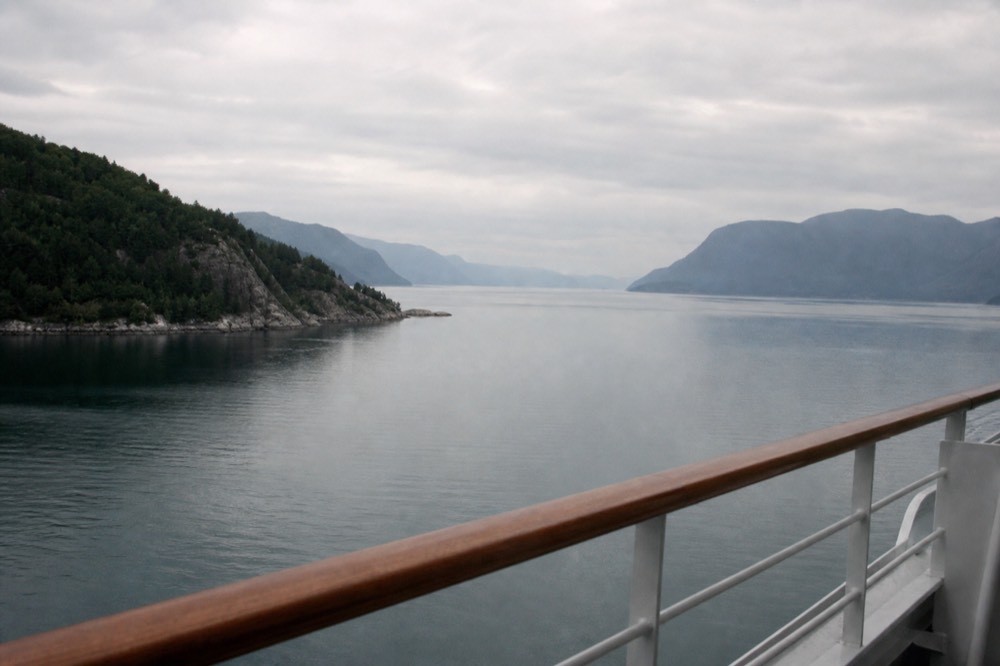
A balcony cabin is the single most debated upgrade in cruise booking, and fjord itineraries make the debate weirder than usual. On a Caribbean run, a balcony is about privacy and sunbathing. On a fjord run, it is about whether you can see a 1,000-meter wall of rock from your own bed without fighting for deck space alongside every other passenger on the ship. That is a genuinely different calculation, and it deserves a genuinely different answer.
Here is the short version, then the long one. Balcony cabins are worth it on scenic fjord sailings when the transit itself is the point of the trip, when you are traveling as a couple, and when the weather window is on your side. They are worth much less on itineraries where the ship docks early and you spend the day ashore, and they are worth almost nothing if you would otherwise spend the whole sailing in the panorama lounge anyway, which on most Norwegian coastal ships is a glass-walled room built for exactly this job. And there is a third option almost nobody considers: on a short fjord cruise out of Oslo, there is no cabin at all, there are shared indoor viewing areas and outdoor decks, and the whole balcony question dissolves.
Is A Balcony Cabin Worth It On A Fjord Cruise?
Yes, if the scenic sailing is the centerpiece of your trip and you will be awake in your cabin during daylight transit, no if your itinerary docks early each day and you mostly sleep on the ship. On classic Norwegian fjord routes the scenery arrives on a schedule, and a balcony only pays for itself when that schedule overlaps with the hours you would otherwise be standing at the rail on a public deck.
The core issue is that fjord scenery is not ambient. It is episodic. A ship entering Geirangerfjord or sailing the inner reaches of a western Norway arm passes the postcard material in concentrated bursts, often an hour or two of cliffs, waterfalls, and abandoned mountain farms, bracketed by long stretches of open water that look like any other coastline. If those bursts land while you are showering, at breakfast, or asleep, the balcony you paid a premium for was furniture.
This is why seasoned fjord cruisers talk about itineraries before cabin categories. A sailing that transits the scenic sections in daylight, at a slow pace, with the ship positioned so both sides get views, rewards a balcony heavily. A port-heavy itinerary where you are off the ship in Flåm or Ålesund by 9 a.m. and back at 5 p.m. rewards it barely at all. You would have watched the fjords from a tender boat, a train, or a viewpoint, and your cabin was a place to sleep.
Weather is the other half of the equation. Western Norway is one of the wetter corners of Europe, and a balcony in steady drizzle with an 8-degree wind is a balcony you will look at through glass. Midsummer itineraries tilt the odds in your favor, with very long daylight hours, which incidentally is also when the midnight sun pushes scenic transit into hours you would otherwise spend in bed. That is the one scenario where a balcony cabin on a fjord cruise becomes close to unarguable: sailing north of the Arctic Circle in June, with the sun circling the horizon at midnight and the cabin's sliding door the only thing between you and a private light show.
Couples get more from balconies than families or solo travelers. Two people can share a rail, a blanket, and a thermos in a way four people cannot, and the per-person premium halves when the cabin holds two. If you are booking a family quad, the balcony surcharge multiplied across a bigger cabin often funds a shore excursion instead, and shore excursions in the fjords, the Flåm Railway, RIB safaris, mountain viewpoints, are frequently what people remember more than the hours on deck.
What Does A Balcony Cabin Actually Cost On A Fjord Cruise?
There is no fixed balcony surcharge: the gap between an inside cabin and a balcony on Norwegian itineraries varies widely depending on season, ship, and how early you book. Treat any specific percentage a booking site shows you as a snapshot, not a rule, and compare the same deck and sailing date before deciding.
The pricing moves for three reasons. Season first: a balcony in the June-to-August window costs disproportionately more than the same cabin in May or September, because demand for scenic sailings concentrates hard into the summer holidays. Book the shoulder months and the balcony premium compresses, which is why many experienced Norway cruisers sail in late May or early September and spend the savings on excursions.
Ship second. Older vessels have fewer balcony cabins, so scarcity inflates the price. Newer ships have balconies on most outside cabins, which pushes the premium down but also means the "upgrade" buys less distinction, when half the ship has the same rail you do. Deck level matters too: a balcony on a high forward deck catches more wind and more spray in the fjords than a midship one, and a sheltered midship balcony on a lower deck is often the better product even when it is priced the same.
Booking timing third. Balcony inventory and discounts vary by ship and departure. If you are flexible, last-minute balcony deals on fjord sailings do exist, but they are a gamble with cabin location, so check the specific cabin location, noise sources and any obstructed-view designation before accepting an offer.
One honest reframe that saves people money every week: the question is rarely "can I afford the balcony." It is "what else could that money do on this trip." On a Norwegian fjord cruise, the alternatives are unusually strong. A shore excursion into the mountains, a dinner at a harborside restaurant in Bergen, or, if you are starting in Oslo, an entire second fjord experience on the water, and that last option deserves its own section later in this article.
Here is how the decision factors stack up against each other:
| Factor | Favors the balcony | Favors the cheaper cabin |
|---|---|---|
| Scenic transit timing | Daylight or midnight-sun sailing | Transit at night or breakfast hours |
| Port time | Transit-heavy, few stops | Docked early, full days ashore |
| Travel party | Couple, sit-still travelers | Families, deck wanderers |
| Season | Midsummer, stable weather | Winter, shoulder-season storms |
| Budget alternative | None competing for the money | Excursions or a small-boat fjord cruise |
If the table points you toward the cheaper cabin, the good news is that the money you save has an unusually good outlet on this route, and we will get to it shortly.
When Does A Balcony Pay Off On A Norwegian Fjord Route?
A balcony pays off when three things line up: the scenic transit happens in daylight, your itinerary spends few hours docked, and you are someone who will actually sit still for an hour watching rock and water. If any one of the three is missing, downgrade the cabin and spend the difference ashore.
The daylight test is the one most people fail to check. Study the sailing schedule before you book, not after. If the ship enters the headline fjord at 6 a.m. and you are not a 5:30 riser, the balcony is a very expensive alarm clock you will not use. Conversely, if the schedule shows an afternoon or evening transit, the balcony becomes the best seat on the ship, because the public decks will be crowded and cold while your rail is private and stocked with whatever you carried up from the buffet.
The port-time test is arithmetic. Add up the hours your itinerary spends at sea versus tied up at a pier. Coastal routes with daily long port stops, where the ship functions as a floating hotel, argue against the balcony. Transit-heavy routes, where some days are almost entirely scenic sailing, argue for it. A one-way Bergen-to-Kirkenes style itinerary behaves differently from a round-trip out of Southampton, and the cabin decision should follow the route, not the brochure photo.
The personality test is the one only you can take. Some travelers are deck people, they want to walk, photograph, move between bow and stern, and no cabin will hold them. Others are sit-still people, give them a chair, a blanket, and a slowly rotating view and they are content for three hours. Balcony cabins are made for the second type. The first type gets equal value from a cheaper inside cabin plus free run of the open decks, and that is not a compromise, it is just a match between temperament and product.
There is also a photography angle worth naming. If you shoot seriously, a balcony gives you a stable, unobstructed, crowd-free platform, and on fjord routes where the light changes by the minute, that is a real advantage over jostling at the rail. But you can rent or bring a fast lens for less than a balcony surcharge, and the panorama lounge's forward windows often frame better compositions than a side balcony anyway. Your call.
What Do You Miss Without A Balcony?
You miss privacy and timing flexibility, not scenery. Many fjord cruise ships have public decks and indoor viewing spaces; their layout and views vary by vessel, so the balcony's real product is the ability to see the fjords on your schedule, in your clothes, without holding a camera over anyone's head.
That is a smaller product than the booking flow makes it feel like. The renderings show a couple with champagne at the rail and imply the views are exclusive. They are not. The ship's outdoor promenade wraps the same cliffs past the same windows for every passenger, and on scenic transits the captain usually announces the highlights so everyone can gather. What the balcony sells is the absence of other people during those moments, plus the option to experience them at 6 a.m. in a bathrobe, and only you know what that is worth to you.
You also miss a private buffer for the rougher bits. Fjord itineraries occasionally cross open stretches, the North Sea legs of coastal routes especially, and a balcony may offer fresh air, but it does not remove the ship’s motion or guarantee relief from seasickness.
What you do not miss is the classic fjord moments themselves. Ships position themselves for the famous passages, slow down for the waterfalls, and in many cases turn slowly so both sides of the vessel get the view. The passenger on deck 7 forward often has the better angle on a wide panorama than the passenger on a side balcony seeing it slide past one window frame. The balcony is a comfort upgrade. It is not a view upgrade, and any marketing that implies otherwise is selling you your own imagination.
Balcony Or Panorama Lounge: Which Is Better In The Fjords?
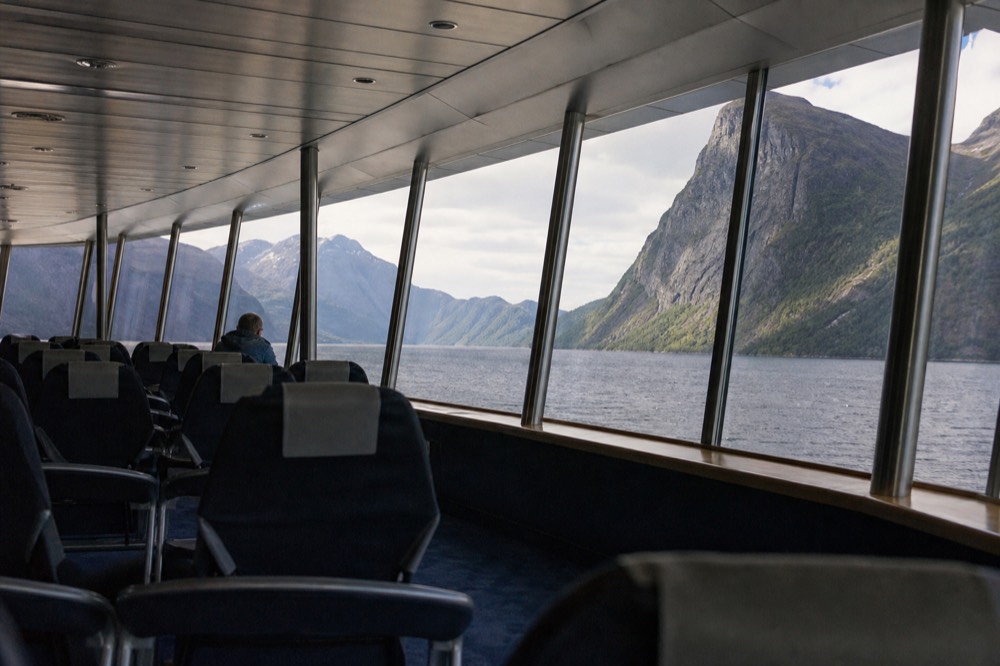
For the big scenic transits, the glass-walled panorama lounge usually beats a balcony, because it is heated, sheltered from wind and spray, and faces forward so you see the fjord opening ahead of the ship rather than sliding past sideways. The balcony wins on privacy, quiet, and the small hours when the lounge is closed or busy with a bar crowd.
Norwegian coastal and fjord ships take their panorama lounges seriously. These are the rooms with floor-to-ceiling glass, reclining chairs, and sightlines down the ship's axis, and in bad weather they are where the entire passenger population wants to be. The lounge's weaknesses are exactly the balcony's strengths: it is shared, it can fill up the moment something spectacular appears, and it closes or converts to a bar in the evening, which is precisely when midsummer light in Norway is at its most cinematic.
The smart play, if the budget allows only one, is to think about when you will want the view. Daytime transit in a group: lounge, because it is social and warm. Dawn and dusk as a couple: balcony, because the lounge will not serve those hours the same way. Families with kids who need to run around: neither, book the cheaper cabin and let the kids use the deck while the adults take lounge shifts.
And if the budget allows neither a balcony premium nor much of anything, remember that the oldest scenic-cruise tradition in Norway predates balconies entirely: dress warmly, claim a spot at the bow rail, and let the wind do the rest. Norwegians have been watching their fjords from open wooden boats for a century and a half, and the modern version of that experience is thriving in Oslo right now, which brings us to the alternative that reframes the whole question. If you are still deciding which style of Norwegian fjord cruise fits your trip in the first place, small boat out of Oslo or a full coastal voyage, our wider comparison of the best cruise to visit the fjords in Norway lays out that broader choice.
Can You Get The Fjord Balcony Experience Without Booking A Cabin?
Yes, and in Oslo it is the default: sightseeing cruises on the Oslofjord have no cabins at all, so passengers share viewing areas; compare the actual day-cruise fare with your own cabin-upgrade quote. The balcony question only exists on overnight itineraries, and Oslo's fjord market sidesteps it entirely.
This is the angle most balcony debates miss. If what you actually want is private-feeling, unhurried time with fjord water and Norwegian coastline, you do not need a floating hotel, you need a good small boat and a free afternoon. Oslo's harbor is one of the few European capitals where that is a 10-minute walk from the main street.
The standout is a guided cruise on a premium silent electric boat from Brim Explorer, 2 hours, electric propulsion, and a 4.7 rating built from 1,775 reviews as of September 2026, with pastries and drinks available from the onboard cafe. The same product lists from $74 on its other listing, so check the selected date for current terms. A silent boat changes the experience more than most people expect: no engine drone, no diesel smell, just hull noise and the guide's commentary, and the fjord's own sounds, gulls, water, the echo off green islands, come through. It is a separate sightseeing option with shared viewing areas.
The traditional alternative is a wooden sailing ship. Båtservice runs a 2-hour wooden-boat sailing cruise that has quietly accumulated 5,881 reviews at a 4.5 rating as of September 2026, making it the most-reviewed fjord product in the Oslo market, with refreshments onboard and a bar. There is something honest about seeing the Oslofjord from the same kind of hull that worked these waters when a "cabin" meant a berth below deck. The same sailing lists from $69 with free cancellation on its second platform listing.
If your fjord itch is bigger than two hours, Oslo covers that too, current as of September 2026. Trollcruise runs a shrimp-based fjord-style dinner cruise with a listed duration of 3–4 hours rated 4.2 from 441 reviews, and Båtservice runs a 3-hour evening cruise with a shrimp buffet on a sailing ship, 4.1 from 182 reviews, blankets provided, which is a very Norwegian detail: the evening light on the Oslofjord in summer is long, gold, and best experienced wrapped in wool. There is even a 90-minute sustainable electric cruise with audio guiding from $46, current pricing as of September 2026, for travelers with just a lunch window, and for groups, a private charter from $1,795 for up to 7 people, which is a separate private outing, not overnight accommodation.
For help choosing between these, our Oslo fjord cruise guide breaks down the full lineup by duration and style, and if you are weighing the whole idea against a bigger western-Norway itinerary, start with is an Oslofjord cruise worth it before you commit money either way.
Should You Book The Balcony Or Spend The Money On The Water?
If your fjord cruise is a multi-day scenic itinerary with daylight transits and you travel as a couple, book the balcony, ideally midship and sheltered. If your itinerary is port-heavy, or you are honestly a deck-wanderer, take the cheaper cabin and put the difference into a small-boat experience, using your actual cabin and excursion quotes to compare the cost.
That last clause is the whole argument compressed. The balcony premium on a week-long fjord sailing can buy several hours of premium small-boat time in Oslo, silent electric or wooden sail, with the inclusions listed for your chosen outing; sightseeing tickets do not automatically include food. One gives you scenery through your own door. The other gives you scenery from a vessel designed for nothing else. Oslofjord Cruises exists because for a lot of travelers, the second option is not the budget compromise, it is the better trip.
Common Questions About Balcony Cabins On Fjord Cruises
These questions come up in almost every balcony-cabin discussion, and the short answers all follow the same logic: match the cabin category to your itinerary and temperament, not to the brochure photo, and remember that the scenery itself is never locked behind a cabin door. The details below cover the specific cases people ask about most.
Is a balcony cabin worth it on a fjord cruise?
It depends on the itinerary more than the fjord. If the scenic sailing happens in daylight and the ship spends limited time in port, a balcony is one of the best upgrades in cruising. If you dock early and explore ashore all day, the balcony mostly sits empty, and the money does more elsewhere.
Do you see more from a balcony than from the deck?
No, you see the same scenery from a different angle. Public decks and panorama lounges often give wider views, especially forward-facing lounges during the famous fjord transits. The balcony's advantage is privacy and timing, not access to better views.
Is a balcony cabin worth it in Norway in winter?
Usually not. Winter light is short, the weather is wet and windy, and scenic transits often happen in darkness. The panorama lounge, heated and glass-walled, serves winter sailings better than an open rail you will use for minutes at a time.
Which side of the ship is better on a fjord cruise?
Neither, for the headline scenery. Ships slow down and often turn during major fjord passages so both sides get the view, and the captain announces highlights. Choose your cabin for deck position and shelter instead, midship and lower is steadier, rather than port versus starboard.
Can I get a fjord view experience without an overnight cruise?
Yes. As of September 2026, sightseeing cruises on the Oslofjord run from an hour and a half to 4 hours with no cabins at all, from a $46 electric cruise to a fjord-style dinner cruise. Sightseeing vessels offer shared viewing areas; a ticket does not guarantee a private balcony or a window seat.
Is a balcony cabin good for seasickness on fjord routes?
A balcony does not guarantee relief from seasickness, and water conditions vary. The open-sea legs of coastal itineraries are the rough parts, and no cabin category changes the motion itself. If you are prone to seasickness, prioritize midship position over balcony category.
Match The Day To Your Plans And Compare Costs
Editorial starting point. Confirm your party's age, access needs and departure details on the listing.
2-Hour Oslo Fjord Sightseeing Cruise by Sailing Ship: English audio commentary, blankets and an open-air wooden boat; refreshments extra 2 hours. Rådhusbrygge 3, Oslo; return to the same pier. Confirm party ages, mobility requirements and the exact departure on the selected listing.
Compare Your Actual Quotes
Compare complete trip quotes in the same currency, with equal transport, meals and nights. Add any optional outing to the cheaper-cabin total. This compares your quotes, not live prices.
The difference is the premium for private outdoor space after accounting for your optional outing. A day cruise does not provide overnight accommodation.